

R-22: Defect or Deferred Maintenance?
- Ethan Martinez

- 1 minute ago
- 5 min read
What homeowners and home buyers should know about older air-conditioning systems
If your home inspection report says “R-22 refrigerant,” should you be worried? Maybe - but probably not for the reason you think.
R-22, also known as HCFC-22, was once one of the most common refrigerants used in residential air-conditioning systems. Today, however, it is a phased-out refrigerant. New R-22 is no longer produced or imported in the United States, although existing R-22 systems can still legally be operated and serviced using recovered, reclaimed, or previously produced refrigerant.
So when an inspector discovers an older air conditioner using R-22, is that a defect? Not necessarily.
In many cases, it's better understood as a maintenance and future replacement consideration, particularly when the system is already showing signs of age, leakage, poor performance, or other deficiencies.
What Exactly Is R-22?
R-22 is a hydrochlorofluorocarbon (HCFC) refrigerant that was widely used in residential air conditioners and heat pumps for decades.
Because HCFCs contribute to ozone depletion, the United States phased out their production and import under the Clean Air Act and international Montreal Protocol agreements.
The important date for homeowners is January 1, 2020.
That's when U.S. production and import of new R-22 ended. The change did not mean that every R-22 air conditioner suddenly became obsolete or had to be replaced.
The EPA specifically states that homeowners can continue using existing R-22 equipment and that EPA does not require premature replacement.
Instead, the industry moved toward servicing existing equipment with R-22 that had already been produced or that has been recovered and reclaimed.
And that's where things get interesting for today's home buyer.
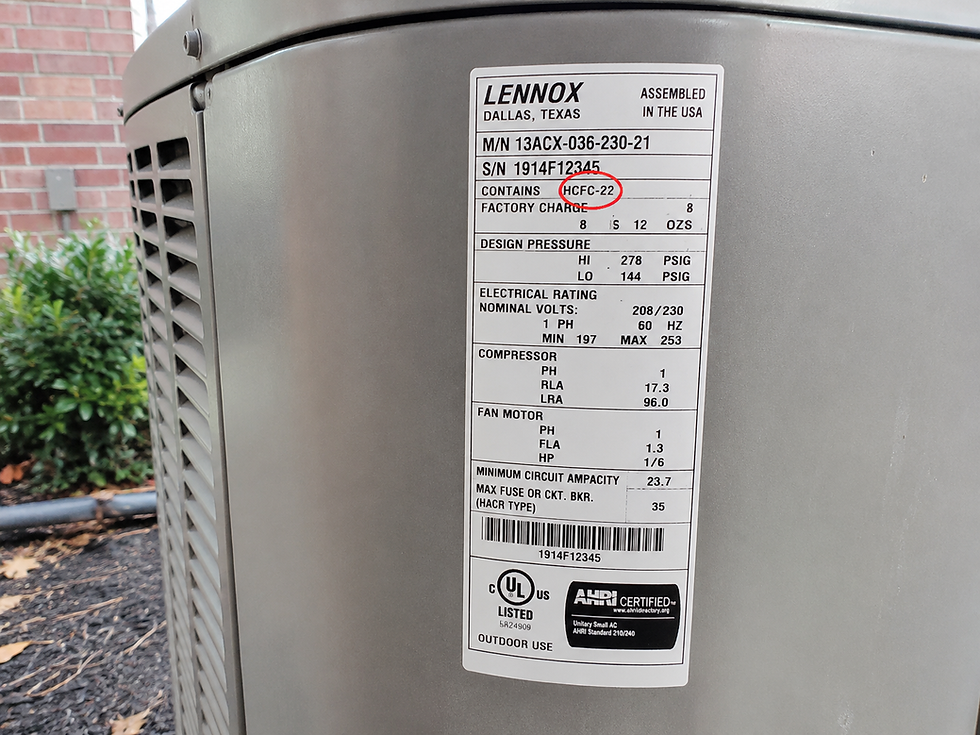
Is R-22 a Defect?
The refrigerant itself? No.
If an older air-conditioning system is operating properly, maintaining appropriate temperatures, and showing no evidence of leakage or other deficiencies, the fact that it uses R-22 does not automatically make the system defective.
An inspector shouldn't recommend replacement solely because the system contains R-22.
That's an important distinction.
A home inspector evaluates the observable condition and performance of the system - not whether the equipment happens to use a refrigerant that is being phased out.
However, the presence of R-22 can be an important future-cost consideration.
Why? Because the system is almost certainly older, and the economics of repairing an aging R-22 system can become less attractive as the equipment gets older.
Why R-22 Repairs Can Become More Expensive
The biggest issue isn't necessarily that R-22 is impossible to obtain.
It's that the supply is no longer being replenished with newly manufactured R-22.
Since 2020, servicing existing systems has relied on previously produced, recovered, or reclaimed R-22.
That means homeowners dealing with an R-22 leak may face a different repair equation than someone with a newer system.
For example, consider an older air conditioner that develops a refrigerant leak.
The repair may involve:
Locating the source of the leak
Repairing the leaking component
Evacuating and properly servicing the system
Recharging it with R-22
Potentially replacing other aging components
The refrigerant itself can be expensive, particularly when a system requires a substantial recharge. And because the system is already older, the homeowner may be spending significant money repairing a component of a system that could eventually need complete replacement.
The EPA notes that reclaimed R-22 remains available for servicing existing equipment, but also warns that supply and price can change as existing supplies are used.
So Should You Replace an R-22 Air Conditioner?
Not automatically.
This is where homeowners and buyers should resist the temptation to make a decision based on the refrigerant alone.
Instead, consider the entire system.
An older R-22 system that is:
Operating normally
Cooling the home adequately
Free of obvious refrigerant leaks
Properly maintained
Not showing significant component deterioration
may be perfectly reasonable to continue operating.
On the other hand, an older R-22 system that is:
Losing refrigerant
Requiring repeated repairs
Struggling to maintain temperature
Showing significant corrosion or deterioration
Experiencing compressor or coil problems
Approaching the end of its useful service life
may make replacement planning much more important.
In other words:
R-22 isn't necessarily the problem. An aging system that happens to use R-22 may be.
What About “Converting” an R-22 System?
This is another area where homeowners should be cautious.
You generally can't simply empty an R-22 system and pour a different refrigerant into it.
Air-conditioning systems are designed around specific refrigerants, pressures, components, and operating characteristics. The EPA notes that replacement refrigerants and system components must be compatible, and homeowners should work with qualified technicians when considering alternatives or replacement.
In many situations, replacing an aging system with a properly matched modern system may make more sense than attempting to keep an increasingly problematic older system alive.
And today's replacement landscape is itself changing, so homeowners should have an HVAC professional evaluate the appropriate current equipment and refrigerant rather than assuming that one particular refrigerant is automatically the correct replacement.
What Should a Home Inspector Report?
This is where the “defect or deferred maintenance?” question becomes especially useful.
An inspector shouldn't simply see “R-22” and write:
“Defective air conditioner. Recommend replacement.”
That's an overly broad conclusion.
Instead, the inspector should evaluate the observable condition and performance of the system and then put the refrigerant into context.
If they find: R-22 + evidence of leakage or poor performance
The inspector has an observable condition that may warrant further evaluation or repair.
The recommendation should focus on the actual deficiency - not simply the fact that the system contains R-22.
What Does This Mean for a Home Buyer?
If you're buying a house with an R-22 air conditioner, don't panic.
Instead, ask four questions:
1. How old is the system?
Age matters because an R-22 system is already an older piece of equipment.
2. Is it operating properly?
Is the system cooling the home adequately? Are there obvious performance concerns?
3. Has it needed refrigerant or major repairs?
A history of repeated refrigerant loss can be much more concerning than simply seeing “R-22” on the equipment label.
4. Can you financially tolerate an eventual replacement?
This may be the most important question of all.
An inspector can tell you what they observe about the equipment.
They can't tell you whether spending $X on a repair makes sense for your particular situation.
That's a decision that depends on your budget, risk tolerance, how long you plan to own the home, and your willingness to replace an aging system.
The Bottom Line
R-22 is not automatically a defect.
It's a phase-out issue attached to an aging piece of equipment.
The EPA allows existing R-22 systems to continue operating and being serviced, and homeowners are not required to prematurely replace them.
But the clock has changed the economics.
As R-22 systems age, homeowners may encounter higher repair costs, limited availability of refrigerant, aging components, and an increasing likelihood that replacement will eventually make more financial sense than continued repair.
So when you see R-22 on a home inspection report, don't automatically think:
“Defect.”
Think:
“How is the system performing today, how old is it, what condition is it in, and am I prepared for the eventual replacement?”
That's a much more useful way to look at an older air-conditioning system.
Arrow Home Inspections' Take:
A phased-out refrigerant doesn't automatically make an air conditioner defective. Condition, performance, age, maintenance history, and the potential cost of future repairs all matter.
When our inspectors identify an older R-22 system, we look beyond the refrigerant label and evaluate the actual condition and observable performance of the equipment so buyers have better information when making their decisions.


Comments